🚨 HOT TAKE: Critics Slam Trump Ceasefire Win as Political Divide Over Iran Explodes 🇺🇸
OBAMA-BIDEN IRAN APOLOGISTS STILL CAN’T RECOGNIZE WHAT WINNING LOOKS LIKE
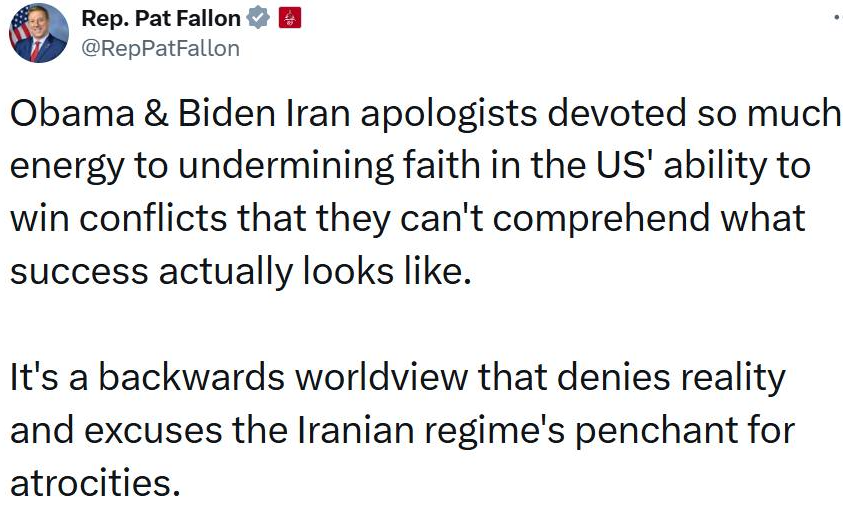
Texas Rep. Pat Fallon just nailed it: years of Obama and Biden coddling the Iranian regime and talking down America’s fighting spirit have left their apologists completely blind to what real success against a terrorist state actually looks like.
Their backwards worldview excused every Iranian atrocity, every hostage-taking, every missile barrage while they undermined faith in U.S. power at every turn. Now, as President Trump forces the mullahs to face consequences for choking the Strait of Hormuz and attacking our allies, the same crowd is still in denial.
No more weakness. No more apologies. Trump is showing the world what strength delivers, and the Iran apologists are left sputtering because they never believed America could win. History is proving them wrong again
A fierce political debate has erupted following the announcement of a temporary ceasefire between the United States and Iran, with reactions sharply divided across party lines. While some view the move as a strategic step toward de-escalation, others remain deeply critical of both the approach and the leadership behind it.
The two-week ceasefire agreement, which includes reopening the Strait of Hormuz and pausing U.S. military strikes, has been described by supporters as a significant breakthrough in a rapidly escalating conflict. The deal helped avoid immediate military escalation and was welcomed internationally as a step back from the brink of a larger war. European leaders, for example, called it an important opportunity to pursue a longer-term diplomatic solution.
However, the reaction within the United States has been far from unified. Critics—particularly among Democratic leaders—have raised concerns about the lead-up to the agreement, pointing to the intense rhetoric and threats that preceded it. Some described the situation as dangerously volatile, arguing that the path to the ceasefire created unnecessary risk.
Supporters, on the other hand, argue that the outcome itself speaks volumes. They emphasize that the agreement reopened a critical global shipping route, stabilized energy markets, and avoided what could have been a devastating military confrontation. From this perspective, the ceasefire represents a clear example of results-driven leadership, where decisive action ultimately led to a tangible outcome.
The broader disagreement highlights a deeper divide in how success in foreign policy is defined. For some, success is measured by avoiding conflict entirely through diplomacy and restraint. For others, it is about applying pressure and leverage to achieve specific outcomes, even if that approach involves risk and strong rhetoric.
This divide is not new. Debates over U.S. policy toward Iran have persisted for years, spanning multiple administrations. Previous strategies focused heavily on diplomatic agreements and negotiations, while more recent approaches have leaned toward pressure and deterrence. Each side continues to argue that its method offers the best path to stability in a complex and volatile region.
What makes the current moment especially intense is the high stakes involved. The Strait of Hormuz is one of the most important waterways in the world, and any disruption there has immediate global consequences. The fact that the ceasefire helped restore passage—at least temporarily—has amplified the significance of the agreement.
At the same time, uncertainty remains. The ceasefire is limited to just two weeks, and both sides have made it clear that future actions will depend on whether the terms are upheld. Analysts warn that without sustained diplomatic progress, tensions could quickly return.
As the situation continues to unfold, one thing is clear: the debate over what constitutes “winning” in foreign policy is far from settled. With strong opinions on both sides, the ceasefire has become more than just a geopolitical development—it is now a defining moment in an ongoing national conversation about leadership, strategy, and results.