California Democrats in Full Panic as GOP Takes Over Governor Race Poll
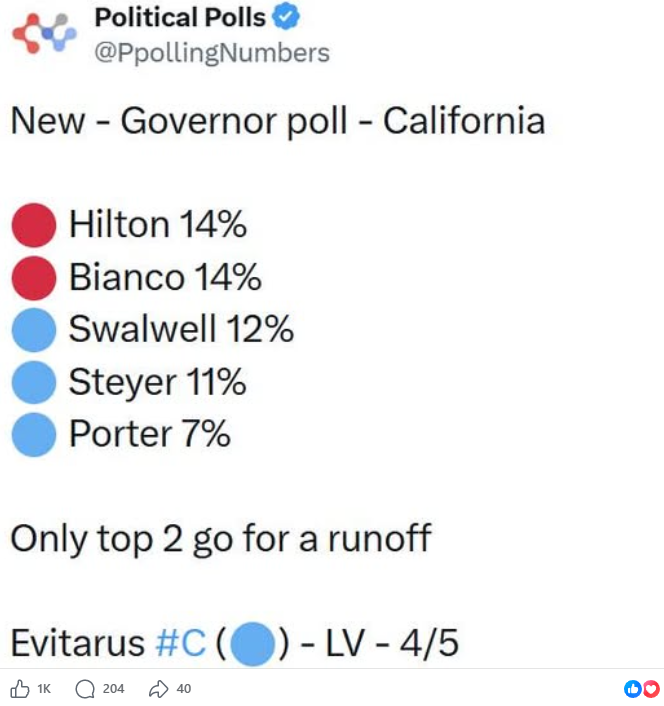
Even in deep-blue California, the left’s house of cards is crumbling. A fresh Evitarus poll commissioned by the California Democratic Party itself shows two Republicans, Steve Hilton and Riverside County Sheriff Chad Bianco, deadlocked at 14 percent among likely voters in the June 2026 gubernatorial primary.
Democrat Eric Swalwell scrapes by with 12 percent, billionaire Tom Steyer grabs 11 percent, and Katie Porter limps in at just 7 percent. The rest of the crowded Democrat field is scattered in the single digits or lower.
Thanks to California’s top-two primary system, only the top two vote-getters advance to November—no matter the party. That means the fractured Democrats could hand the general election ballot to two conservatives, locking out the party that has ruled the state like a one-party fiefdom for decades.
This isn’t some outlier. Multiple recent surveys paint the same picture: Democrat vote-splitting is handing the momentum to Hilton, the sharp-tongued former Fox News host and Trump ally, and Bianco, the no-nonsense sheriff who’s taken on the state’s crime and chaos.
While Gavin Newsom’s disastrous legacy of high taxes, open borders, skyrocketing costs, and failing cities lingers, California voters are waking up. The left’s endless identity politics and virtue-signaling have left their own voters uninspired and divided.
Democrat leaders are sweating bullets, desperately urging candidates to drop out before it’s too late. But the damage is done. If this poll holds, Californians could finally get a real choice in November—one that puts law and order, fiscal sanity, and common sense back on the table.
The blue wall is cracking. Even the Democrats’ own pollsters can’t hide it anymore.
A surprising new poll is sending shockwaves through California politics, signaling a potential shift in a state long dominated by Democrats. The survey, commissioned by the California Democratic Party, suggests that the 2026 gubernatorial race is far more competitive than many expected—and that internal divisions could reshape the outcome in a dramatic way.
According to the poll, two Republican candidates—Steve Hilton and Riverside County Sheriff Chad Bianco—are currently tied at 14 percent among likely voters in the upcoming June primary. Meanwhile, leading Democratic contenders are trailing behind in a fragmented field. Representative Eric Swalwell registers at 12 percent, businessman Tom Steyer follows with 11 percent, and Representative Katie Porter sits at 7 percent. Other Democratic candidates are polling in the single digits or lower, reflecting a crowded and divided field.
California’s unique “top-two” primary system adds a critical twist to the race. Under this system, the two candidates who receive the most votes in the primary—regardless of party affiliation—advance to the general election. This means that if Democratic voters remain split across multiple candidates, it is mathematically possible for two Republicans to secure the top spots and move forward to November, leaving Democrats off the final ballot entirely.
Political analysts note that this scenario, while unusual, is not impossible. With a large number of Democratic candidates dividing the vote, even a modest but unified Republican base could gain a strategic advantage. Recent polling trends appear to reinforce this concern, showing consistent support for Hilton and Bianco as recognizable figures consolidating conservative voters.
The broader political environment may also be playing a role. Issues such as the cost of living, housing affordability, public safety, and economic pressures continue to dominate voter concerns across the state. Some voters have expressed frustration with the status quo, while others remain committed to current leadership and policies. This mix of sentiment is contributing to an unpredictable and fluid race.
Behind the scenes, there are reports that some Democratic leaders are encouraging consolidation within their party to avoid vote-splitting. The idea is to rally support around fewer candidates to strengthen their chances of securing a spot in the general election. However, with the primary approaching and multiple campaigns already in motion, achieving that unity may prove challenging.
Despite the early nature of the polling, the implications are significant. If current trends hold, California could see one of its most competitive gubernatorial elections in years. The possibility of a general election without a Democratic candidate would mark a historic shift in the state’s political landscape.
For now, the race remains wide open. Voter turnout, campaign strategy, and potential shifts in public opinion will all play a major role in determining the final outcome. But one thing is clear: what was once considered a predictable contest is now shaping up to be anything but.